Introduction
A risky payment change usually does not begin as a dramatic attack. It arrives as a normal request. A supplier asks for new account details. A manager forwards an urgent invoice. A team member says the payment must move today. The danger is that the request looks like administration, so nobody treats it as a decision.
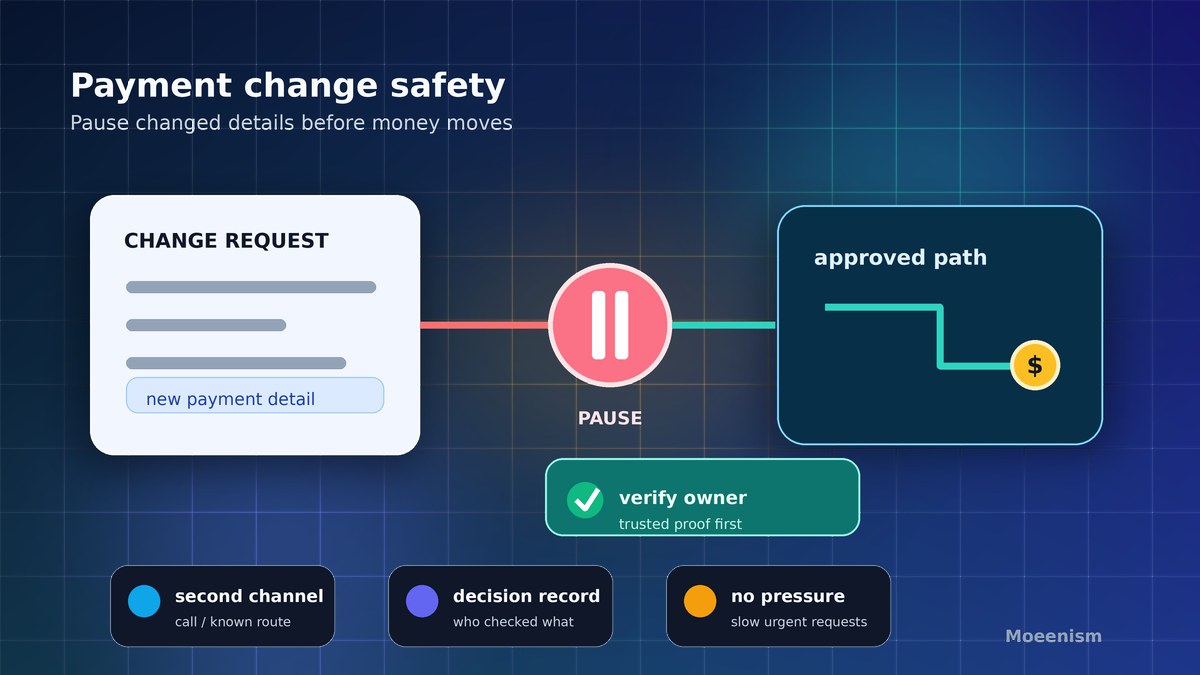
Moeenism’s position is simple: payment change safety is not a finance-only task. It is a team decision rule. Before money leaves, the team should prove three things: who requested the change, who owns the relationship, and what independent check confirmed the new detail. If those three facts are missing, the safest answer is not no forever. It is pause until the evidence is clear.
Key Takeaways
- A changed payment detail should be treated as a fresh approval, not as a small admin edit.
- The strongest control is a short pause that uses a second channel, a named owner, and a written record.
- Urgency is a signal to slow down, not a reason to skip checks.
- The process must be light enough for small teams to use without creating a heavy committee.
- This is general safety guidance, not legal, accounting, or financial advice.
What common payment advice misses
Most advice tells people to watch for phishing, check sender addresses, and avoid suspicious links. That matters. However, payment loss often happens after the message has already reached a real person who wants to be helpful. The practical question is not only, “Is this email fake?” It is, “Should this change be trusted enough to move money?”
That difference matters because a team can have good awareness and still fail at ownership. If everyone assumes someone else checked the detail, the process has a hole. If the person approving the payment is also the only person confirming the change, the team has no second view. If the record only says “approved,” a later review cannot show what was actually checked.
For a broader culture approach, Moeenism has already argued for security awareness without fear. The same idea applies here. The goal is not to blame people for trusting a message. The goal is to make the safe path easier than the rushed path.
The Moeenism payment-change pause
The payment-change pause is a small rule for a high-risk moment. Use it when bank details, payee details, invoice instructions, payment timing, or the payment route changes. It does not replace formal finance controls. Instead, it gives a small team a plain operating habit before a request becomes a loss.
| Check | Question to ask | Pass sign | Stop sign |
|---|---|---|---|
| Known owner | Who owns the supplier or payment relationship? | A named person accepts ownership. | Nobody can name the owner. |
| Second channel | Was the change confirmed outside the original message? | A trusted number or known portal is used. | Only the message thread confirms it. |
| Reason | Why did the detail or timing change? | The reason is clear and expected. | The explanation is vague or pressured. |
| Record | Can a later reviewer see what was checked? | The owner, channel, date, and outcome are recorded. | The record only says approved. |
| Pressure | Is the request trying to beat the process? | Urgency is explained and checked. | The request says not to call or verify. |
| Fallback | What happens if the check is not complete? | Payment waits without blame. | The team pays because delay feels awkward. |
How to use the pause without slowing every invoice
1. Trigger it only for change
Do not turn every normal payment into a meeting. The pause is for changed details, new payees, unusual timing, unexpected urgency, or instructions that bypass the normal path. Therefore, a routine invoice can still move quickly, while a changed request gets more care.
2. Separate the requester from the verifier
The person who receives the request should not be the only person who confirms it. A second person does not need to be senior in every case. However, they should be independent enough to ask, “What evidence do we have?” This stops politeness from becoming the control.
3. Use trusted contact paths
If a message provides a new phone number, link, or contact address, do not use that as the only proof. Use a number already held in a trusted record, a known supplier portal, or an existing relationship owner. This small rule is often the difference between checking the source and checking the attacker’s script.
4. Record the decision in plain words
The record does not need to be long. It should state the request, owner, second channel, result, and final decision. If your team already keeps a decision record, connect this habit to that system. Moeenism’s guide to a simple decision log for digital teams explains why a short record can save time later.
5. Keep the no-blame option visible
A good control gives people a safe phrase. For example: “This is a payment change, so we need to verify it first.” That sentence removes personal judgement from the moment. Instead of accusing anyone, the team follows the rule.
Signals that should stop the payment
Some signals deserve a harder pause. Stop if the request asks people not to call, changes account details at the last moment, uses pressure about penalties, asks for secrecy, or avoids the normal owner. Also stop if the sign-in or email account behind the request looks doubtful. In that case, use account-safety guidance such as Microsoft 365 sign-in safety before trusting the message path.
However, do not make the rule so strict that people hide exceptions. A good process explains what to do next: who to ask, what proof is enough, and when a leader must decide. If the request involves a new tool or permission path, compare the same ownership idea with browser extension safety: know what changed, who owns it, and how to reverse it.
What leaders should not do
Do not rely only on annual training. Training helps people notice warning signs, but payment risk lives in the process. Also, do not tell teams to “be careful” without giving them a decision rule. Careful people still make rushed decisions when the next step is unclear.
Most importantly, do not punish a reasonable pause. If the process says verification is required, a team member should not feel embarrassed for delaying a payment. The point is to protect the business relationship and the team at the same time.
Frequently Asked Questions
Is this only for large companies?
No. Small teams need this even more because one person often handles several roles. A lightweight check can reduce risk without adding a large control department.
Should every invoice need two approvals?
Not always. The stronger trigger is change. If payment details, timing, owner, or route changes, add the second check. Keep routine work simple.
What if the supplier is waiting?
Tell the supplier that the team verifies payment changes as a safety rule. A genuine supplier should understand a short verification step.
Can software solve this alone?
Software can help, but the team still needs ownership. A tool cannot decide whether a rushed request makes sense in context.
Sources
- FTC: Scams and Your Small Business — A Guide for Business
- FTC: Cybersecurity for Small Business
- CISA: Teach Employees to Avoid Phishing
- Microsoft: What is Business Email Compromise?
Conclusion
Payment change safety works when the rule is simple enough to use under pressure. Treat a changed payment detail as a new decision. Name the owner. Confirm through a trusted second channel. Record what was checked. Then pay only when the story makes sense.
The value is not in slowing honest work. The value is in making one risky moment visible before money leaves the team.